
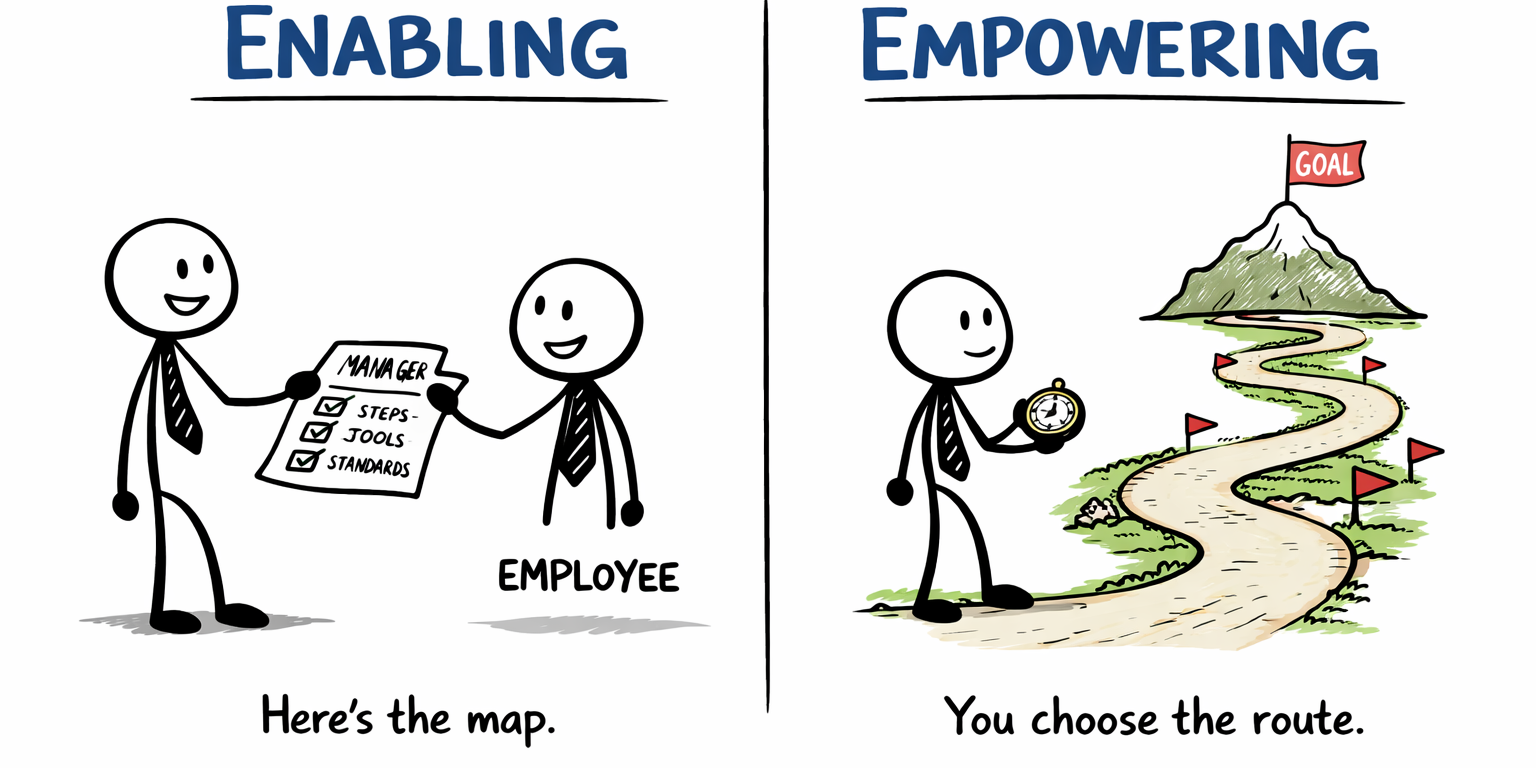
“Empower your people.”
We hear this advice all the time. But in many workplaces, especially fast-paced teams, empowerment gets misunderstood. Leaders delegate something big, step back, and call it empowerment.
Then results fall short. People hesitate. Mistakes happen. And the leader concludes, “Hindi pa ready ang team ko.”
Sometimes the problem isn’t readiness. The problem is sequence.
A better principle is this:
Enable before you empower.
Enabling vs Empowering: Similar, but not the same
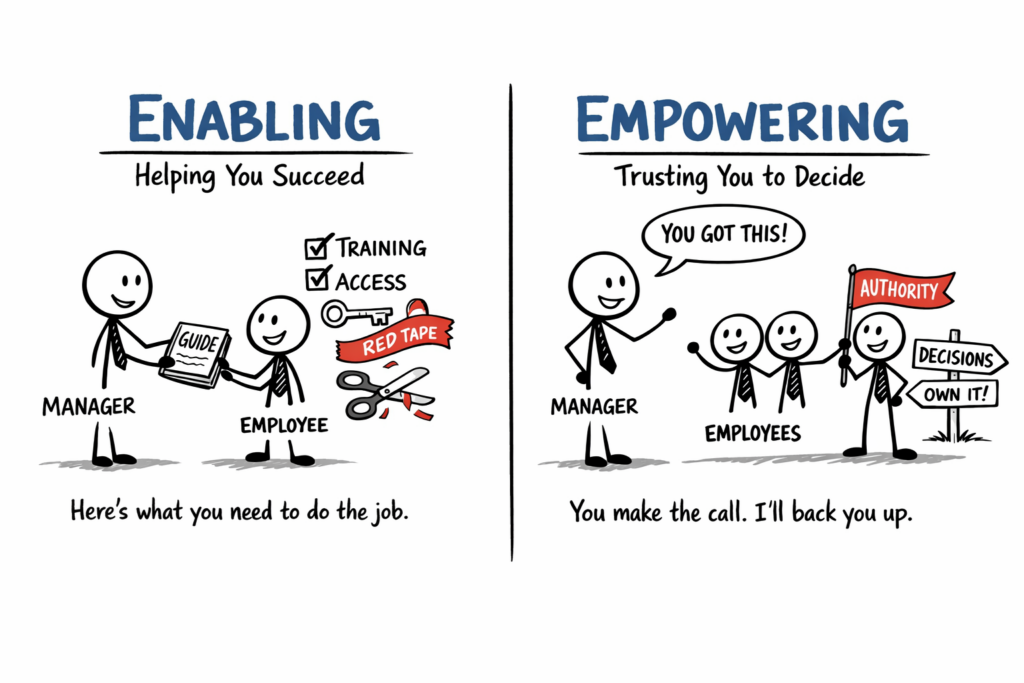 They often sound interchangeable, but they create different outcomes.
Enabling is about making success possible.
You provide what people need to perform well: clarity, tools, access, coaching, and fewer blockers.
Think of enabling as answering this question:
“What do you need so you can do this job well?”
Empowering is about giving ownership and decision space.
You give authority, boundaries, and accountability. You allow people to decide and act without needing you every step of the way.
Think of empowering as answering this question:
“What decisions can you make without my approval, and what results will you own?”
A useful shorthand:
- Enabling = capability + support
- Empowering = autonomy + accountability
The two common leadership mistakes
1) Empowering without enabling (abandonment disguised as empowerment)
This happens when a leader says, “Ikaw na bahala,” but the person has:
- unclear expectations
- no playbook or standards
- limited access to info, tools, or stakeholders
- no practice, coaching, or feedback
- no guardrails
That’s not empowerment. That’s pressure.
It creates anxiety, slow decision-making, and inconsistent execution. People will still ask permission constantly because they don’t feel safe to decide.
2) Enabling without empowering (support that creates dependency)
This happens when leaders are highly supportive but still keep all decisions with them:
- leader rescues too quickly
- leader becomes the bottleneck for approvals
- team waits for the “final say”
- team’s initiative slowly drops
You’ll hear it in language like:
“Boss, okay lang ba?”
“Boss, approve mo.”
“Boss, ikaw na lang.”
Over time, this becomes a culture of dependency, not ownership.
The right sequence: Enable first, then empower (with guardrails)
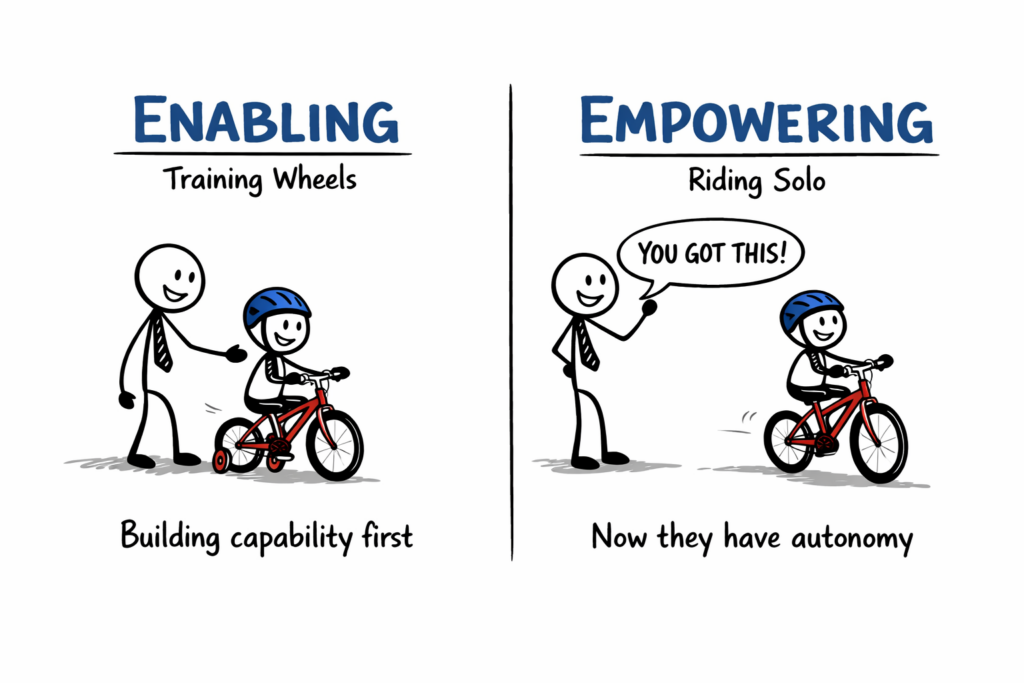 If you want a team that owns outcomes, you build it in stages:
Step 1: Enable
- clarify what “good” looks like (standards, success indicators)
- provide tools, templates, and process guides
- ensure access to systems, data, and key stakeholders
- remove unnecessary red tape
- coach and give feedback (especially early)
Step 2: Empower
- delegate decisions, not just tasks
- define guardrails (limits, escalation rules, non-negotiables)
- allow people to make reasonable calls
- back them up when they operate within the boundaries
- hold them accountable for outcomes
Step 3: Review and expand
- conduct short debriefs (“What worked? What didn’t? What will we adjust?”)
- widen decision authority as competence and trust grow
This is how you scale leadership without turning yourself into a bottleneck.
A simple example (you can apply today)
Let’s say someone is handling customer complaints.
Enable:
- give a complaint-handling guide
- provide scripts and response standards
- clarify escalation rules
- ensure access to customer history
- coach after difficult cases
Empower:
- give decision authority, e.g. “You can approve a resolution up to ₱X without my sign-off”
- clarify guardrails, e.g. “If it’s beyond ₱X or involves a legal risk, escalate”
Now you’re building both competence and ownership.
A quick self-check for leaders
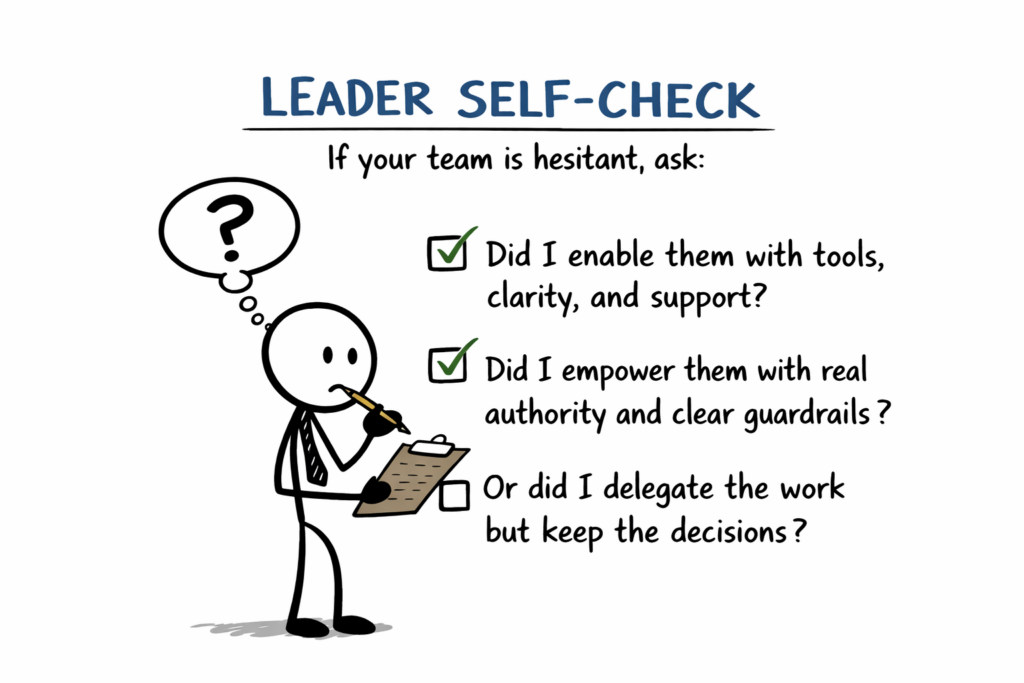 If your team hesitates, it may not be attitude. It may be that they’re not enabled yet.
The point
Empowerment is not a motivational speech. It’s a design decision.
Enable before you empower.
Because empowerment without enabling feels like pressure.
And enabling without empowering creates dependency.
If you want ownership, build the capability and the decision space—step by step.
Final note: coaching, delegation, and decision authority are learnable leadership skills. The more you invest in learning how to develop people, the more you build a team that can truly own the work.