Kindly note that all rates indicated are already inclusive of VAT.
| Date | Early Bird Rate | Regular Rate |
|---|---|---|
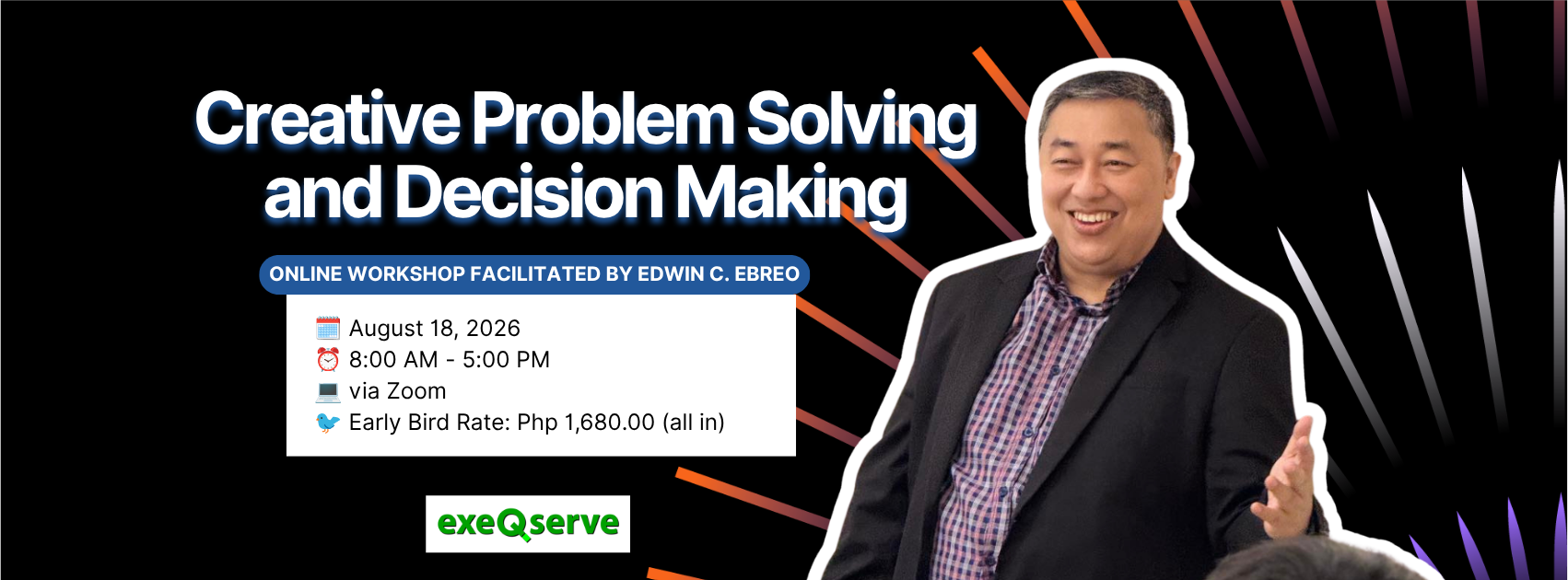
| August 18 | Php 1,680 | Php 2,240 |
Just Released! 📘 Grab a copy of Edwin C. Ebreo's first physical book “Aba! Bossing Ka Na Pala” — now available at the ExeQserve Store! Dismiss

Kindly note that all rates indicated are already inclusive of VAT.
| Date | Early Bird Rate | Regular Rate |
|---|---|---|
| August 18 | Php 1,680 | Php 2,240 |
Leaders and professionals are expected to solve problems and make decisions every day. Some problems are simple and only require the right procedure. Some are complicated and require analysis. Some are complex and need experimentation. Some are urgent and chaotic, requiring fast action before deeper analysis can happen.
The problem is that many people use the same approach for different kinds of problems. They jump to solutions too quickly. They rely on familiar answers. They brainstorm without first understanding the issue. They delay decisions because they are afraid to make a mistake. Or they make decisions without clear criteria, buy-in, or implementation plans.
This one-day live online workshop is designed to help leaders and professionals analyze problems more clearly, generate better options, make sound decisions, and present practical solutions with stronger confidence.
This is not a lecture-heavy creativity session. It is a practical problem-solving and decision-making workshop for people who need to handle real workplace issues, make better choices, and move solutions forward.
By the end of the workshop, participants will be able to:
The workshop will use practical and interactive online learning methods, including:
This workshop is ideal for:
Workplace problems do not improve just because people talk about them. They improve when people understand the issue correctly, generate better options, make sound decisions, and follow through on implementation.
Many professionals are busy solving symptoms while the real causes remain untouched. Others have good ideas but struggle to organize them, evaluate them, or present them convincingly.
This workshop helps participants move from reactive problem-solving to disciplined and creative decision-making. They will learn practical tools for understanding problems, generating options, choosing solutions, gaining buy-in, and turning decisions into action.
By the end of the workshop, participants will produce: