Kindly note that all rates indicated are already inclusive of VAT.
| Date | Registration Fee | 4+1 Group Promo |
|---|---|---|
| July 8 | Php 2,240 | Php 8,960 |
Just Released! 📘 Grab a copy of Edwin C. Ebreo's first physical book “Aba! Bossing Ka Na Pala” — now available at the ExeQserve Store! Dismiss

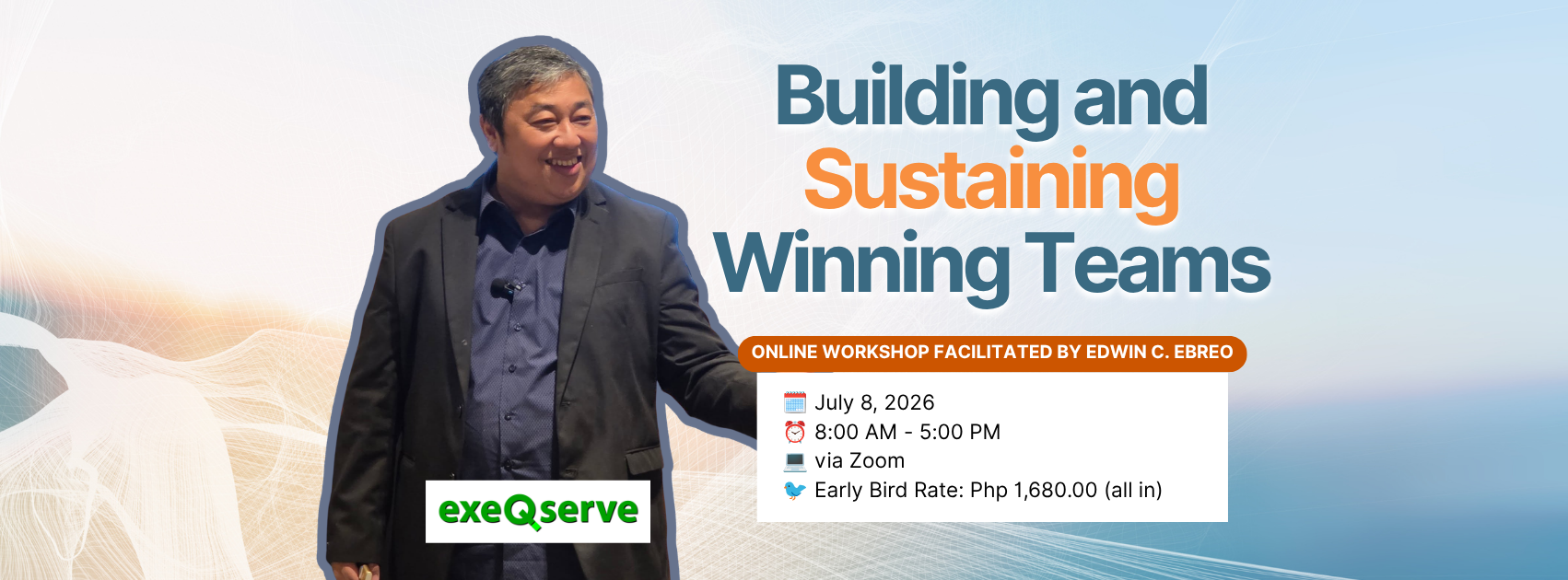
Kindly note that all rates indicated are already inclusive of VAT.
| Date | Registration Fee | 4+1 Group Promo |
|---|---|---|
| July 8 | Php 2,240 | Php 8,960 |
Strong teams do not happen by accident. They are built through trust, clear expectations, open communication, healthy conflict, shared commitment, mutual accountability, and focus on results.
Many teams struggle not because people lack talent, but because the team lacks the right habits and agreements. People work hard, but not always together. They communicate, but not always clearly. They attend meetings, but do not always commit. They avoid conflict, tolerate poor follow-through, and lose sight of team goals.
This one-day live online workshop is designed to help leaders and team members understand what it takes to build and sustain a winning team. It provides practical tools for strengthening trust, improving collaboration, clarifying expectations, handling conflict, building commitment, reinforcing accountability, and keeping the team focused on shared results.
This is not a motivational team-building session filled with games that do not connect to work. It is a practical team development workshop for leaders and teams who want stronger teamwork, better execution, and clearer shared ownership.
By the end of the workshop, participants will be able to:
The workshop will use practical and interactive online learning methods, including:
This workshop is ideal for:
A winning team is not simply a group of good performers. It is a group of people who know how to trust each other, communicate clearly, handle conflict, commit to shared goals, hold each other accountable, and stay focused on results.
When teams do not have these habits, leaders spend too much time fixing misunderstandings, chasing follow-through, mediating avoidable conflict, and reminding people of commitments that should have been clear from the start.
This workshop helps leaders and teams build the practical habits that make teamwork easier, clearer, and more productive. Participants will leave with tools they can use immediately to strengthen trust, improve communication, clarify commitments, and sustain team performance.
By the end of the workshop, participants will produce: