

One of the most common reasons promotions fail is simple: we promote the best individual contributor, then we expect them to magically become a leader.
Top performers are valuable. But leadership and management roles demand a different set of capabilities. The job changes. The success measures change. The risks get bigger—because when leaders struggle, teams suffer.
That’s why promotion decisions should not rely on performance ratings alone. You also need to assess leadership and management potential—the traits that predict whether someone can grow into bigger responsibilities without breaking under pressure or pulling the team down.
This infographic highlights six leadership and management potentials that can help you make smarter promotion decisions.
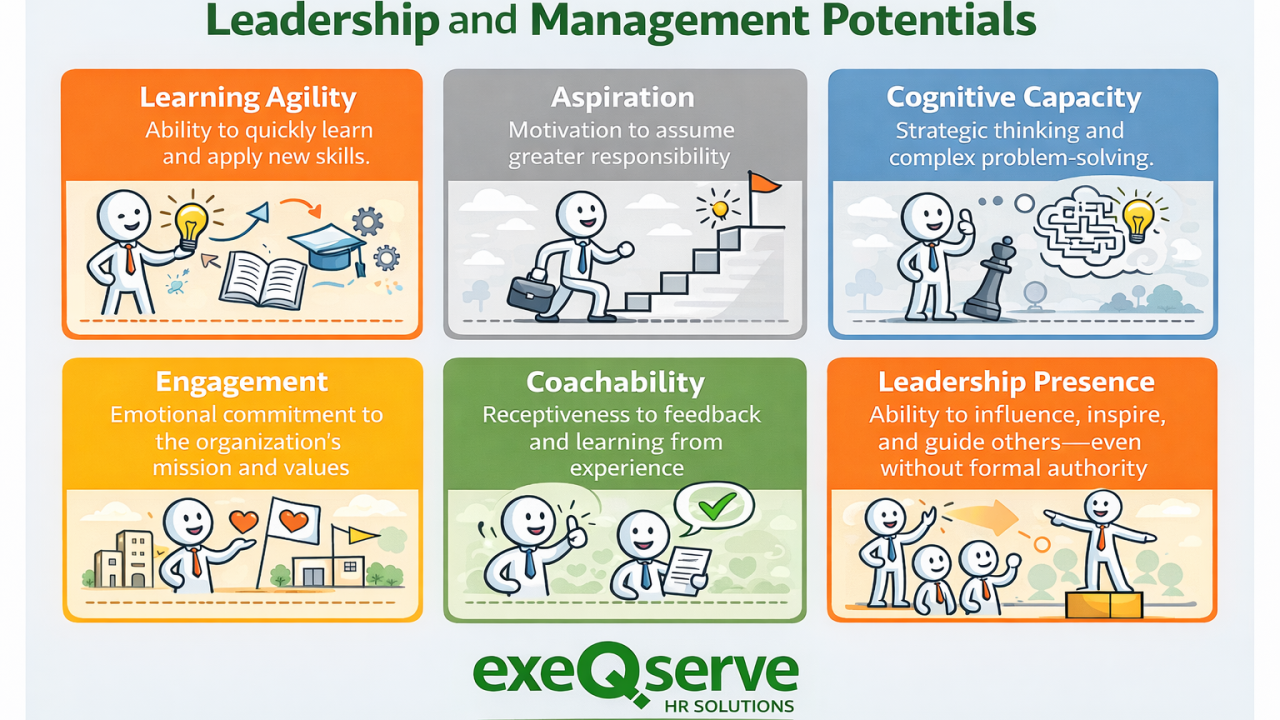
1) Learning Agility: Can this person grow fast enough for the next role?
Promotions often come with new tasks, new stakeholders, and new problems. The best candidates are not those who “already know everything.” They are those who can learn quickly, adjust, and apply lessons in a new context.
What it looks like at the high end (Score 5):
- Actively seeks learning
- Adapts rapidly
- Thrives in ambiguity and new challenges
Red flags (Scores 1–2):
- Avoids change
- Repeats mistakes
- Slow to adapt even after feedback
Why it matters: In leadership roles, situations evolve fast. If someone struggles with learning agility, they will lag behind the role, and the team will pay the price.
2) Aspiration: Do they truly want the responsibility?
Some employees are talented but don’t want leadership responsibilities. And that’s okay. Leadership is not a reward; it’s a responsibility.
Aspiration reflects whether a person is internally motivated to take on bigger challenges and lead others—not just to get a higher title or pay grade.
High aspiration (Score 5):
- Proactively seeks leadership roles
- Volunteers for bigger challenges
Low aspiration (Scores 1–2):
- Passive about growth
- Rarely steps up
- Uninterested in additional responsibility
Why it matters: People who don’t want the role often resist the hard parts of leadership—coaching, accountability, decision-making, and conflict management.

3) Engagement: Will they lead with commitment—or just comply?
Engagement is emotional commitment to the organization’s mission and values. You don’t want leaders who are technically strong but emotionally detached, cynical, or indifferent—because leadership multiplies behavior. Whatever attitude a leader has, the team will eventually copy it.
Highly engaged (Score 5):
- Strong alignment with purpose
- Inspires others through commitment
Disengaged (Scores 1–2):
- Withdrawn, uninvolved, or negative
- Shows apathy
Why it matters: Leaders shape culture. If you promote someone with poor engagement, you may be promoting a future source of demotivation.
4) Cognitive Capacity: Can they handle complexity and make good judgments?
Leadership work is less about doing tasks and more about making decisions—often with incomplete data, time pressure, and competing priorities.
Cognitive capacity includes strategic thinking, pattern recognition, and complex problem-solving.
High cognitive capacity (Score 5):
- Thinks long-term
- Identifies patterns
- Creates innovative solutions
Low cognitive capacity (Scores 1–2):
- Struggles with ambiguity
- Avoids decision-making
- Weak critical thinking
Why it matters: A leader who cannot think beyond the immediate task will keep solving symptoms instead of root causes.

5) Coachability: Will they improve—or defend themselves?
The higher the role, the more feedback you receive. If someone cannot accept feedback now, it will get worse later when the stakes are bigger.
Coachability measures willingness to receive feedback, reflect, adjust, and improve.
Highly coachable (Score 5):
- Seeks feedback proactively
- Improves rapidly
Poor coachability (Scores 1–2):
- Defensive
- Inconsistent follow-through
- Rejects feedback, little behavior change
Why it matters: Coaching is how leaders grow. If the person is uncoachable, the organization will have limited options to develop them once promoted.
6) Leadership Potential: Can they influence without authority?
This is a critical indicator. Before someone becomes a formal leader, you can already see whether people naturally listen to them, trust them, and follow them.
Leadership potential is the ability to influence, inspire, and guide others—even without a title.
High leadership potential (Score 5):
- Commands respect naturally
- Aligns and energizes teams
- Trusted by peers
Low leadership potential (Scores 1–2):
- Struggles to gain trust
- Avoids leadership opportunities
- Poor influence
Why it matters: A promotion gives authority, but it doesn’t automatically give followership. If people don’t want to follow you, the role becomes heavy and stressful—for everyone.
How to Use These Potentials in Promotion Decisions
Here’s a practical approach:
- Use performance as an entry requirement
- Use the six potentials as predictors of readiness
- Avoid promoting based on one strength
- Use the scoring tool to reduce bias
A Straight Opinion: Promotions Should Be Earned Twice
First, earned through performance. Second, earned through potential.
When you promote people without assessing potential, you’re gambling with your team’s productivity, morale, and culture. But when you promote with both performance and potential in mind, you increase your odds of building leaders who can carry responsibility, develop others, and help the organization win.
If you want better leaders, don’t just promote who performed well. Promote who can grow, lead, and learn.