Many organizations say they have a performance management system, but what they really have is a performance appraisal system.
Once or twice a year, managers are asked to rate employees, complete forms, justify scores, and discuss results. After that, everyone goes back to work until the next cycle.
The problem is that this does not necessarily improve performance.
Gallup found that only 14% of employees strongly agree that their performance reviews inspire them to improve. In another Gallup study, only 2% of Fortune 500 CHROs strongly agreed that their performance management system inspires employees to improve. That is a serious warning for organizations that still treat performance management mainly as appraisal, rating, and compliance.
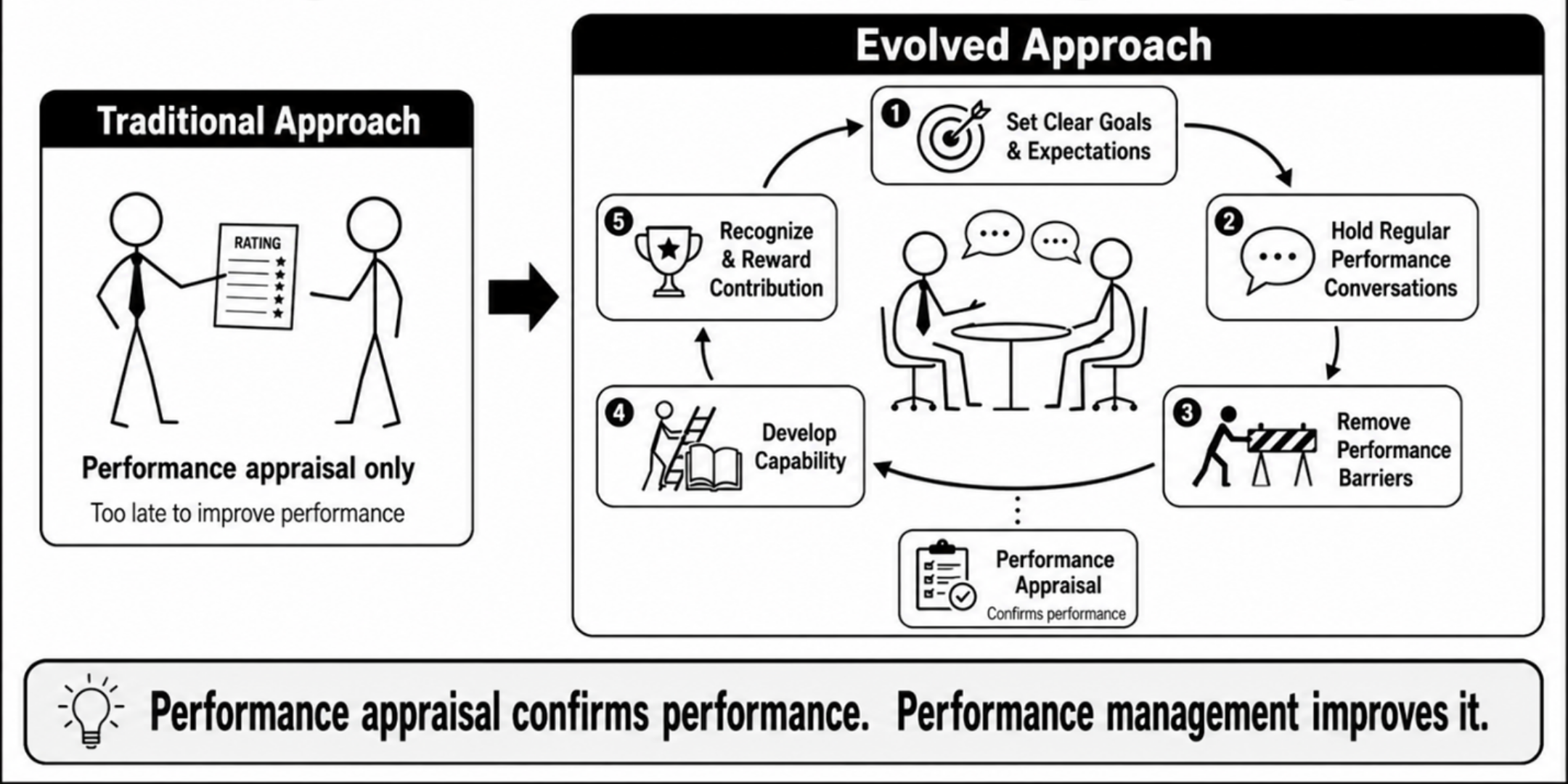
Performance appraisal has a role, but it is a small part of performance management. It confirms performance. It documents results. It supports decisions on rewards, movement, and development. But the real work happens before and after the appraisal.
Before appraisal, managers must clarify expectations. Employees need to know what goals they are expected to achieve, what standards will be used to measure success, and what behaviors are expected of them. Without this clarity, people may be busy but misaligned. They may be working hard but not necessarily working on what matters most.
This is especially important in many Filipino workplaces where employees may hesitate to ask questions because they do not want to appear difficult, disrespectful, or incompetent. Silence does not always mean understanding. A good performance management system helps managers make expectations clear before employees are judged against them.

The next important practice is regular performance conversations. Feedback should not wait until the year-end review. Gallup found that 80% of employees who received meaningful feedback in the past week were fully engaged. This shows the value of timely, useful, and regular manager-employee conversations.
These conversations do not have to be long. They only need to be consistent. Managers should regularly ask: What progress has been made? What priorities have changed? What obstacles are getting in the way? What support is needed? What behavior should continue, improve, or stop?
Performance management must also address barriers to performance. Sometimes employees fail not because they lack commitment, but because the system around them is unclear or broken. They may lack tools, training, authority, information, manpower, or support from other teams. If these issues are not discussed early, the appraisal becomes a blame exercise.
A better system asks two questions: Did the employee deliver? And did we create the conditions that allowed the employee to deliver?

Development is another critical part of performance management. When performance gaps appear, the answer should not only be rating, warning, or documentation. Managers must also ask what capability needs to be built. Is the gap caused by lack of skill, poor planning, weak communication, low confidence, unclear priorities, or insufficient coaching?
McKinsey reported that companies focusing on people performance are 4.2 times more likely to outperform peers, with 30% higher revenue growth on average and lower attrition. This reinforces the point that performance management should not be limited to evaluation. It should help people grow in ways that improve business results.
Recognition and rewards also matter. Employees need to know that useful effort, good behavior, and meaningful contribution are seen. If managers only notice mistakes, people eventually learn that extra effort is not worth it. Recognition reinforces what the organization wants repeated.

As an HROD consultant, I have helped companies develop and improve their performance management systems. This includes clarifying KRAs and KPIs, defining behavioral expectations, designing appraisal tools, aligning performance measures with business goals, and training managers on how to manage performance through expectations-setting, feedback, coaching, documentation, and performance conversations.
One thing I have learned is this: managers do not automatically know how to manage performance just because they were promoted. They need tools, structure, practice, and support.
The appraisal form is not the system. The rating scale is not the system. The online platform is not the system.
The real system is the discipline of clarifying goals, aligning expectations, holding regular conversations, removing barriers, developing capability, recognizing contribution, and holding people accountable.
Performance appraisal confirms performance. Performance management improves it. That is the evolution organizations need.
Check out ExeQserve’s Performance Management Workshop and Performance Management System Development and Implementation.