
Many L&D managers are still trapped in event management mode.
They coordinate schedules, secure venues, process suppliers, monitor attendance, collect evaluation forms, and report training hours. These tasks are necessary, but they are not enough. When L&D managers ask for big training budgets but cannot show proof of relevant change afterward, the issue is often not the trainer, the course, or the participants.
The issue is that training was treated as an event, not as a performance intervention.
The Kirkpatrick Model reminds us that training evaluation must go beyond participant reaction and learning. Real value is seen when learning is applied as workplace behavior and eventually contributes to business results. In other words, attendance and satisfaction scores are weak evidence. Behavior change and performance improvement are stronger evidence.
This is also why the 70-20-10 model remains a useful reminder. The Center for Creative Leadership describes it as a guideline where development happens through challenging experiences, developmental relationships, and formal coursework. The point is not to worship the numbers. The point is to remember that classroom learning is only one part of development. People build skill when they apply, receive feedback, get coached, and practice in real work situations.
This is where many L&D efforts fail.

The training program ends, the participants return to work, and nothing in the workplace supports application. The line manager does not ask what was learned. There is no post-training assignment. No one observes whether behavior changed. No barriers are removed. No coaching happens. No follow-through is scheduled.
Then after a few months, management asks, “What was the ROI?”
By then, it is too late.
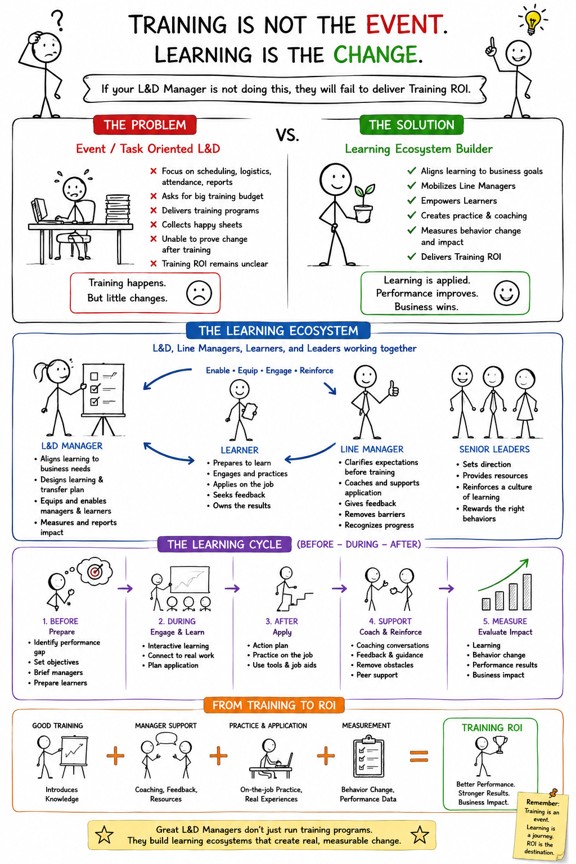
Training ROI is not created during the seminar alone. It is created before, during, and after the learning event. It requires a healthy learning ecosystem where L&D, line managers, learners, and senior leaders play their roles.
This is consistent with the direction of the Philippine Society for Talent Development. PSTD describes its Philippine Talent Development Framework as a strategic guide that equips talent developers with the knowledge, skills, and tools needed to cultivate Filipino talent and help individuals contribute to the broader goals of their organizations and society. PSTD also defines the Training Manager Certification as covering the ability to plan and manage training and development needs, develop training plans, formulate policies, evaluate programs, align them with the organization’s vision and mission, and monitor the impact of training strategies.

That is a much bigger role than course administration.
A capable L&D manager must be able to build the mechanism for learning transfer. This means helping line managers clarify expectations before training, preparing learners to apply what they learned, designing practice opportunities, setting up coaching and feedback routines, and measuring evidence of workplace application.
In simpler terms, L&D managers must stop asking only, “What training do we need to run?”
They must also ask:
“What business result are we trying to improve?”
“What behavior must change?”
“What support will learners need from their managers?”
“How will they practice?”
“How will we know that learning was applied?”
“What will we measure after the training?”
This is where substantial leadership is required.
The L&D manager must mobilize line managers, not merely invite them. They must educate leaders that training does not work well when managers outsource development entirely to HR. They must make learners accountable, not merely present. They must help senior leaders see that ROI is a shared responsibility.
A learning ecosystem works when formal training introduces the knowledge, line managers reinforce the behavior, learners practice deliberately, and the organization rewards the right application.
Without this ecosystem, training becomes a recurring expense.
With this ecosystem, training becomes a business investment.
So, if your L&D manager is only busy organizing programs, collecting attendance, and reporting training hours, do not expect strong ROI. Those are activity metrics.
A serious L&D manager must be able to connect learning to performance, performance to business needs, and business needs to measurable results.
That is the difference between running training and leading talent development.
L&D Manager Readiness Checklist: Can They Really Deliver Training ROI?
Use this checklist to assess whether your L&D manager is doing the work needed to build a real learning ecosystem.
| Capability Area | Checklist Question | Yes/No |
| Business Alignment | Does the L&D manager clarify the business problem or performance gap before recommending training? | |
| Needs Analysis | Do they distinguish between training issues and non-training issues such as unclear standards, poor tools, weak supervision, or broken processes? | |
| Learning Objectives | Are learning objectives linked to observable workplace behaviors, not just topics to be covered? | |
| Line Manager Involvement | Are line managers briefed on their role before, during, and after the training? | |
| Learner Accountability | Are participants required to prepare, participate, apply, and report back on learning application? | |
| Learning Transfer | Is there a post-training mechanism such as action plans, workplace assignments, coaching guides, peer check-ins, or application reviews? | |
| Practice and Feedback | Are learners given opportunities to practice new skills and receive feedback from managers or coaches? | |
| Evaluation | Does evaluation go beyond satisfaction forms and include learning, behavior, and performance indicators? | |
| Performance Support | Are tools, job aids, templates, checklists, or coaching guides provided to help learners apply the learning at work? | |
| Stakeholder Mobilization | Can the L&D manager influence senior leaders and line managers to support the learning ecosystem? | |
| Impact Reporting | Can they report evidence of application, improvement, and business relevance, not just attendance and training hours? | |
| Continuous Improvement | Are training results used to improve future programs, manager support, and workplace systems? |
How to Read the Result
If most answers are No, the L&D function is probably still event-driven.
If most answers are Yes, the L&D manager is likely operating as a true talent development partner.
The difference matters. Event-driven L&D consumes budget. Ecosystem-driven L&D creates value.
At ExeQserve, we support L&D Managers in delivering ROI by ensuring alignment of training with needs, and creating capstones and learning action plans for learners to accomplish after the training. Contact us if you want the partnership.